Automate Invoices in 2026: 5 DMS Solutions Compared
Mandatory e-invoice receipt since September 2026: certified platform or DMS, what Deltic, Zeendoc, Dext, Open Bee and Konica Minolta do, and their real pricing.

Written by Alexis Morain
TL;DR
Since September 1, 2026, every VAT-registered business must be able to receive its invoices through a certified platform, and SMBs will issue them in turn in September 2027. The platform makes you compliant, it doesn't save you a single hour: reading, approval, accounting entry and archiving are what cost time, and that's a DMS's job. I compared five French solutions that cover this workflow. No price can be compared as is, because each one bills by document volume.
What this comparison is, and what it isn't
What I did
- ✅ Read each vendor's offer and pricing pages on October 21, 2026
- ✅ Checked who is a certified platform itself and who goes through a partner
- ✅ Checked the integrator Deltic in the national business registry
What I didn't do
- ❌ Use these tools on a real invoice flow, so no score out of 10
- ❌ Reuse the entry prices circulating about these tools: three out of four don't survive verification
What the reform requires since September 1, 2026
The reform imposes two separate obligations: receiving electronic invoices from September 2026, then issuing them depending on company size.
The calendar is now fixed. Receiving is mandatory for all VAT-registered businesses since September 1, 2026. Issuing has been mandatory since the same date for large companies and mid-market companies, and will be on September 1, 2027 for SMBs, micro-businesses and sole traders. A PDF invoice sent by email no longer counts as an electronic invoice: you need a structured format, Factur-X, UBL or CII.
These invoices go through a certified platform, the former "partner dematerialization platform" renamed in 2025. Counts published in mid-October list more than 150. The only authoritative list is the tax authority's (DGFiP), on impots.gouv.fr. The public invoicing portal, for its part, no longer transmits your invoices: it maintains the national directory and centralizes tax data.
On penalties, an invoice not issued in electronic format costs a €15 fine, capped at €15,000 a year. The amount is small, the real risk is elsewhere: a large-account customer that can no longer process your invoice pays it late.
Many management software vendors settled the question by becoming a certified platform or connecting to one. Pennylane and Qonto are certified, Sage and Cegid too, while EBP goes through Shine. I detailed these choices vendor by vendor in my invoicing software guide.
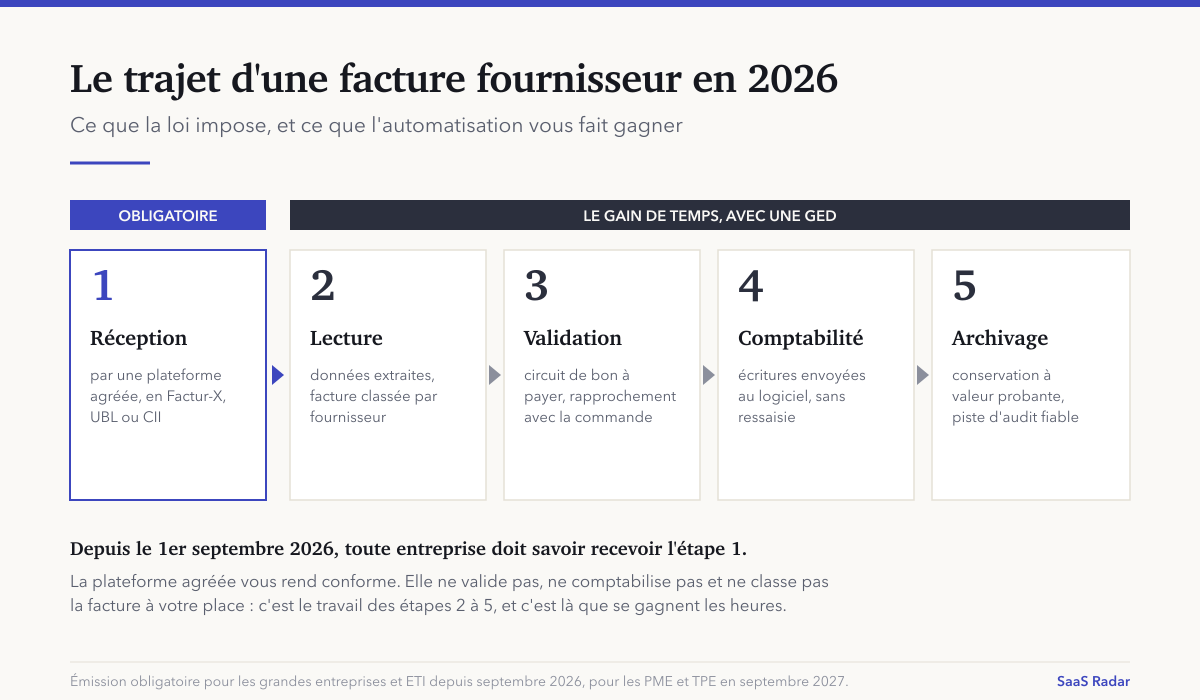 The certified platform covers step 1. The next four are the ones that eat your accounting team's time.
Certified platform and DMS: two jobs that comparisons mix up
A certified platform carries the invoice and reports its data to the tax authority, while a DMS reads it, gets it approved, books it and archives it.
This is the confusion that skews most comparisons on the subject, including the one I'm drawing on here: an integrator, a DMS vendor, a receipt-capture tool and a printer manufacturer all sit on the same line. They aren't direct competitors, and their entry price doesn't measure the same thing.
The distinction matters for a simple reason. An SMB that receives 300 supplier invoices a month is compliant as soon as it has designated its platform. It still opens them one by one, looks for who must approve them, re-keys them and files them. Compliance is settled, the lost time isn't.
A DMS takes over where the platform stops. It extracts the invoice data, files it by supplier, sends it to the right approver, matches it with the purchase order, pushes the entry to the accounting software and keeps the original with evidentiary value. Almost all DMS vendors have therefore added a certified platform to their offer, of their own or through a partner.
Three questions settle your choice: how many invoices do you process a year, on which accounting software, and do you need a multi-level approval workflow. A freelancer with 20 invoices a month doesn't need a DMS. A multi-site distributor with 15,000 documents a year won't do without one.
Five solutions to automate supplier invoices
The five solutions selected cover the full workflow, but only two show an entry price that I could read on their own site.
| Solution | What it is | Certified platform | Public price read on 10/21/2026 |
|---|---|---|---|
| Deltic | DMS integrator (Zeendoc, DocuWare) | Through the deployed solution | From €155/month for 3,000 documents/year, plus setup |
| Zeendoc | French DMS vendor | Through certified partners, Doxallia and Esalink | Nano plan at €65/month, by quote beyond |
| Dext | Receipt capture and reading | Announced by the vendor | Pricing page unavailable |
| Open Bee | DMS vendor | Native module, registration announced | On request |
| Konica Minolta | Manufacturer and DMS integrator | Not claimed | By quote |
Three entry prices circulate about these tools: €29 for Zeendoc, €30 for Open Bee, €45 for Konica Minolta. None appears on the relevant vendor's site. The lowest price Zeendoc publishes is €65, and Open Bee and Konica Minolta publish none.
Deltic, the integrator that chooses the platform with you
Deltic doesn't publish software: it's a DMS integrator based in Lagord, near La Rochelle, that deploys Zeendoc and DocuWare for its customers. The company that runs it, D'Matic, has been registered since 2013 and reported between 10 and 19 employees in 2024. Deltic presents itself as a "Platinium" partner of both vendors and claims more than 1,000 customer companies.
Its appeal comes from this dual catalog. Zeendoc relies on two partner certified platforms, while DocuWare is certified itself. An integrator offering both can steer you based on your volume and your accounting software, instead of selling you the only product it distributes. Deltic's page on the partner dematerialization platform sums up the subject well: definitions, calendar, selection criteria and budget.
Prices are public, which is rare in the category. The Essentielle plan starts at €155 a month for 3,000 documents a year, with unlimited users, automatic reading and filing. The Avancée plan starts at €295 a month for 9,000 documents and adds the approval workflow, the accounting gateway and the invoice collector. Beyond that, the Premium plan is by quote. A free 15-day trial is offered with no credit card.
The point of attention is written on the same page: service fees come on top of the subscription, calculated in days of setup and training. That's the normal model for an integrator, and it's what makes the difference with a tool you configure yourself. Just ask for the number of days in writing before signing.
Zeendoc, the French DMS that publishes an entry price
Zeendoc is the vendor that Deltic deploys most. Its Nano plan, designed for micro-businesses, costs €65 a month for 9 users and 600 invoices a year. It includes the certified platform with evidentiary archiving, a Factur-X converter, an approval workflow, customer reminders and a Chorus Pro connector.
Beyond that, the Bronze, Silver and Gold plans go up to more than 18,000 documents a year, with unlimited users and storage, all by quote. E-signature, ERP connectors and bank reconciliation are options. The Zeendoc pricing has the merit of explaining that the price follows incoming flows, not the number of people.
Dext, receipt capture for accounting firms
Dext comes from another world: capturing invoices and receipts for micro-businesses and accounting firms. The tool reads the receipt, extracts amounts and VAT, then sends it to the accounting software. Dext announces it has become a certified platform, at no extra cost for its subscribers.
It isn't a DMS in the sense of Zeendoc or DocuWare: no multi-level payment approval workflow and no general document archiving. It's an excellent data entry tool. Its French pricing page was unavailable the day I checked, so I'm not reusing any price.
Open Bee, the certified platform built into the DMS
Open Bee made the clearest choice: a native certified platform module in all three of its plans, Essential up to 49 employees, Advanced from 50 to 249, Enterprise beyond. The vendor says it is registered with the DGFiP and shows ISO 27001 certification and hosting in France. The Open Bee plans page details what each tier covers.
The differences are in the details. Factur-X is included everywhere, UBL and CII only from Advanced. The approval workflow is single-step in Essential, configurable above. Evidentiary archiving for 10 years is included from the entry tier. No price is published, you have to ask. According to Compta Online, Open Bee joined the Konica Minolta group in September 2026.
Konica Minolta, the support of a large group
Konica Minolta is first known for printing, but its DMS arm covers the whole supplier invoice workflow: collection, data recognition, operator checks, approval workflow, filing and integration into Sage, Cegid or EBP. Archiving goes through a vault certified NF 203.
Its argument is physical presence, with more than 1,800 professionals in France. Its e-invoicing page still names Chorus Pro as the public portal and doesn't claim its own certification: have them state in writing which certified platform carries your flows. Pricing goes through an online quote.
What invoice automation really costs
The budget has three line items: the DMS subscription, the certified platform and the deployment, and the third is the one people forget.
Published subscriptions give an order of magnitude. A micro-business at 600 invoices a year starts around €65 a month, platform included. An SMB at 3,000 documents a year sits around €155 a month, and near €295 at 9,000 documents. Certified platforms alone range from free to more than €500 a month depending on volume and automation.
Deployment changes the equation. Connecting the DMS to your ERP, configuring approval workflows and training teams is priced in service days. An offer without setup fees isn't necessarily cheaper: either you do this work yourself, or it doesn't get done.
To compare two quotes, reduce them to a cost per processed invoice over three years, setup included. An offer at €155 a month for 3,000 documents comes to about €0.62 per document before setup. Compare that figure to the time one person spends today keying in, getting approved and filing an invoice.
What if you're a micro-business or a freelancer?
Below a few dozen invoices a month, your invoicing software or your bank is enough, provided it's certified or connected.
Indy and Tiime cover the freelancer who keeps their own books. Pennylane fits as soon as the accountant enters the loop, and I compared its limits with Qonto's in Pennylane vs Qonto. For an SMB that wants sales and invoicing in the same tool, Sellsy and Axonaut are the two French options to look at.
A DMS becomes worthwhile when three signals appear: several approvers per invoice, matching against purchase orders, and archives you must be able to retrieve in case of an audit. If your accounting already runs on Sage, my guide Sage Software 2026 details the connection to the vendor's certified platform.
The five questions to ask before signing
A DMS quote is judged on five precise answers, which the vendor or integrator must give you in writing.
- Which certified platform carries my flows, and is it on the DGFiP list? A DMS that "relies on" a partner is compliant, provided you know which one.
- How does the price change with volume? Almost all these offers bill per document. Ask for the rate at your volume in two years, not today.
- How many setup days, and at what daily rate? That's the line that makes a quote vary by a factor of two.
- Which native connectors with my accounting software? A file export isn't an integration. Have them name Sage, Cegid or your ERP explicitly.
- What will I get back if I leave? Invoices, their metadata and their evidence file must come out in a format readable elsewhere.
What I checked, and how
Every price quoted comes from the vendor's or integrator's page, read on October 21, 2026. When a page was unavailable or published no price, I say so rather than reuse a third-party figure.
Deltic was checked in the national business registry: the brand is operated by the company D'Matic, registered in 2013 in Lagord, with 10 to 19 employees. Each solution's certified platform status comes from its own claim. Check it on the official DGFiP list before signing.
I have not been a customer of any of these solutions. This comparison therefore doesn't say which is best, it says what each one really does, and what it costs when it publishes it.
Key takeaways
- Receiving electronic invoices has been mandatory for all companies since September 1, 2026, and issuing them will be for SMBs and micro-businesses in September 2027.
- A certified platform makes you compliant. Time is saved on reading, approval, booking and archiving, which are a DMS's job.
- Only Zeendoc (€65 a month) and Deltic (from €155 a month) publish an entry price. The lower prices circulating about these tools don't appear on their sites.
- Compare quotes as cost per invoice over three years, setup included.
- Always have the certified platform that carries your flows named, and check it on the DGFiP list.